“Who Burns for the Perfection of Paper” by Martín Espada
At sixteen, I worked after high school hours
at a printing plant
that manufactured legal pads:
Yellow paper
stacked seven feet high
and leaning
as I slipped cardboard
between the pages,
then brushed red glue
up and down the stack.
No gloves: fingertips required
for the perfection of paper,
smoothing the exact rectangle.
Sluggish by 9 PM, the hands
would slide along suddenly sharp paper,
and gather slits thinner than the crevices
of the skin, hidden.
Then the glue would sting,
hands oozing
till both palms burned
at the punchclock.
Ten years later, in law school,
I knew that every legal pad
was glued with the sting of hidden cuts,
that every open lawbook
was a pair of hands
upturned and burning.
“When Death Comes” by Mary Oliver
When death comes
like the hungry bear in autumn;
when death comes and takes all the bright coins from his purse to
buy me, and snaps the purse shut;
when death comes
like the measle-pox
when death comes
like an iceberg between the shoulder blades,
I want to step through the door full of curiosity, wondering:
what is it going to be like, that cottage of darkness?
And therefore I look upon everything
as a brotherhood and a sisterhood,
and I look upon time as no more than an idea,
and I consider eternity as another possibility,
and I think of each life as a flower, as common
as a field daisy, and as singular,
and each name a comfortable music in the mouth,
tending, as all music does, toward silence,
and each body a lion of courage, and something
precious to the earth.
When it’s over, I want to say all my life
I was a bride married to amazement.
I was the bridegroom, taking the world into my arms.
When it’s over, I don’t want to wonder
if I have made of my life something particular, and real.
I don’t want to find myself sighing and frightened,
or full of argument.
I don’t want to end up simply having visited this world
“How Things Work” by Gary Soto
Today it’s going to cost us twenty dollars
To live. Five for a softball. Four for a book,
A handful of ones for coffee and two sweet rolls,
Bus fare, rosin for your mother’s violin.
We’re completing our task. The tip I left
For the waitress filters down
Like rain, wetting the new roots of a child
Perhaps, a belligerent cat that won’t let go
Of a balled sock until there’s chicken to eat.
As far as I can tell, daughter, it works like this:
You buy bread from a grocery, a bag of apples
From a fruit stand, and what coins
Are passed on helps others buy pencils, glue,
Tickets to a movie in which laughter
Is thrown into their faces.
If we buy a goldfish, someone tries on a hat.
If we buy crayons, someone walks home with a broom.
A tip, a small purchase here and there,
And things just keep going. I guess.
“Dinosaurs in the Hood” by Danez Smith
Let’s make a movie called Dinosaurs in the Hood.
Jurassic Park meets Friday meets The Pursuit of Happiness.
There should be a scene where a little black boy is playing
with a toy dinosaur on the bus, then looks out the window
& sees the T. Rex, because there has to be a T. Rex.
Don’t let Tarantino direct this. In his version, the boy plays
with a gun, the metaphor: black boys toy with their own lives,
the foreshadow to his end, the spitting image of his father.
Fuck that, the kid has a plastic Brontosaurus or Triceratops
& this is his proof of magic or God or Santa. I want a scene
where a cop car gets pooped on by a pterodactyl, a scene
where the corner store turns into a battle ground. Don’t let
the Wayans brothers in this movie. I don’t want any racist shit
about Asian people or overused Latino stereotypes.
This movie is about a neighborhood of royal folks —
children of slaves & immigrants & addicts & exiles — saving
their town
from real-ass dinosaurs. I don’t want some cheesy yet progressive
Hmong sexy hot dude hero with a funny yet strong commanding
black girl buddy-cop film. This is not a vehicle for Will Smith
& Sofia Vergara. I want grandmas on the front porch taking out raptors
with guns they hid in walls & under mattresses. I want those little
spitty,
screamy dinosaurs. I want Cicely Tyson to make a speech, maybe two.
I want Viola Davis to save the city in the last scene with a black fist afro
pick
through the last dinosaur’s long, cold-blood neck. But this can’t be
a black movie. This can’t be a black movie. This movie can’t be dismissed
because of its cast or its audience. This movie can’t be a metaphor
for black people & extinction. This movie can’t be about race.
This movie can’t be about black pain or cause black people pain.
This movie can’t be about a long history of having a long history with hurt.
This movie can’t be about race. Nobody can say nigga in this movie
who can’t say it to my face in public. No chicken jokes in this movie.
No bullets in the heroes. & no one kills the black boy. & no one kills
the black boy. & no one kills the black boy. Besides, the only reason
I want to make this is for that first scene anyway: the little black boy
on the bus with a toy dinosaur, his eyes wide & endless
his dreams possible, pulsing, & right there.
“September 1, 1939” by W. H. Auden
I sit in one of the dives
On Fifty-second Street
Uncertain and afraid
As the clever hopes expire
Of a low dishonest decade:
Waves of anger and fear
Circulate over the bright
And darkened lands of the earth,
Obsessing our private lives;
The unmentionable odour of death
Offends the September night.
Accurate scholarship can
Unearth the whole offence
From Luther until now
That has driven a culture mad,
Find what occurred at Linz,
What huge imago made
A psychopathic god:
I and the public know
What all schoolchildren learn,
Those to whom evil is done
Do evil in return.
Exiled Thucydides knew
All that a speech can say
About Democracy,
And what dictators do,
The elderly rubbish they talk
To an apathetic grave;
Analysed all in his book,
The enlightenment driven away,
The habit-forming pain,
Mismanagement and grief:
We must suffer them all again.
Into this neutral air
Where blind skyscrapers use
Their full height to proclaim
The strength of Collective Man,
Each language pours its vain
Competitive excuse:
But who can live for long
In an euphoric dream;
Out of the mirror they stare,
Imperialism’s face
And the international wrong.
Faces along the bar
Cling to their average day:
The lights must never go out,
The music must always play,
All the conventions conspire
To make this fort assume
The furniture of home;
Lest we should see where we are,
Lost in a haunted wood,
Children afraid of the night
Who have never been happy or good.
The windiest militant trash
Important Persons shout
Is not so crude as our wish:
What mad Nijinsky wrote
About Diaghilev
Is true of the normal heart;
For the error bred in the bone
Of each woman and each man
Craves what it cannot have,
Not universal love
But to be loved alone.
From the conservative dark
Into the ethical life
The dense commuters come,
Repeating their morning vow;
“I will be true to the wife,
I’ll concentrate more on my work,”
And helpless governors wake
To resume their compulsory game:
Who can release them now,
Who can reach the deaf,
Who can speak for the dumb?
All I have is a voice
To undo the folded lie,
The romantic lie in the brain
Of the sensual man-in-the-street
And the lie of Authority
Whose buildings grope the sky:
There is no such thing as the State
And no one exists alone;
Hunger allows no choice
To the citizen or the police;
We must love one another or die.
Defenceless under the night
Our world in stupor lies;
Yet, dotted everywhere,
Ironic points of light
Flash out wherever the Just
Exchange their messages:
May I, composed like them
Of Eros and of dust,
Beleaguered by the same
Negation and despair,
Show an affirming flame.
“For a Coming Extinction” by W. S. Merwin
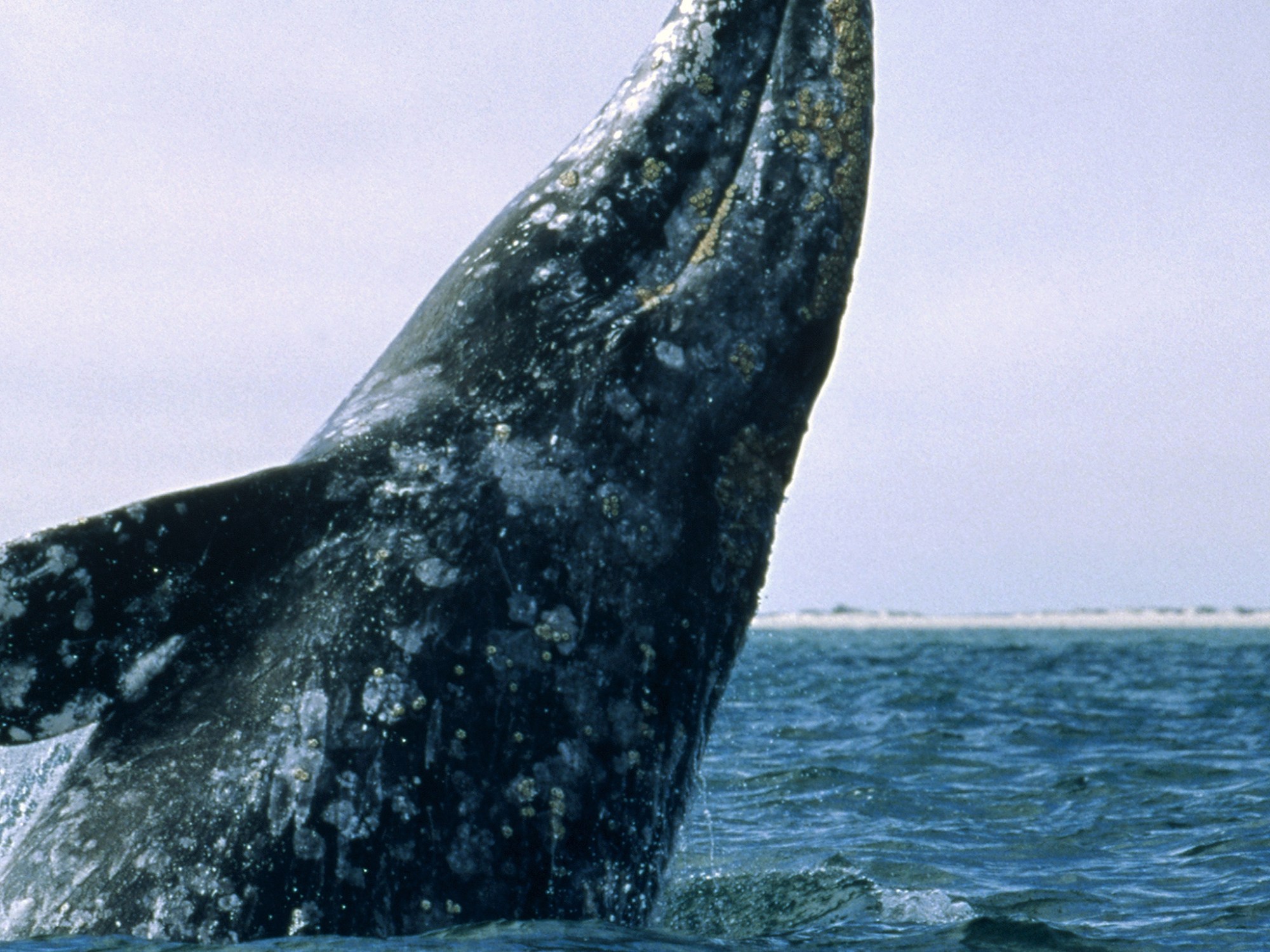
Gray whale
Now that we are sending you to The End
That great god
Tell him
That we who follow you invented forgiveness
And forgive nothing
I write as though you could understand
And I could say it
One must always pretend something
Among the dying
When you have left the seas nodding on their stalks
Empty of you
Tell him that we were made
On another day
The bewilderment will diminish like an echo
Winding along your inner mountains
Unheard by us
And find its way out
Leaving behind it the future
Dead
And ours
When you will not see again
The whale calves trying the light
Consider what you will find in the black garden
And its court
The sea cows the Great Auks the gorillas
The irreplaceable hosts ranged countless
And fore-ordaining as stars
Our sacrifices
Join your word to theirs
Tell him
That it is we who are important
“Hard Rock Returns to Prison from the Hospital for the Criminal Insane” by Etheridge Knight
Hard Rock / was / “known not to take no shit
From nobody,” and he had the scars to prove it:
Split purple lips, lumbed ears, welts above
His yellow eyes, and one long scar that cut
Across his temple and plowed through a thick
Canopy of kinky hair.
The WORD / was / that Hard Rock wasn’t a mean nigger
Anymore, that the doctors had bored a hole in his head,
Cut out part of his brain, and shot electricity
Through the rest. When they brought Hard Rock back,
Handcuffed and chained, he was turned loose,
Like a freshly gelded stallion, to try his new status.
And we all waited and watched, like a herd of sheep,
To see if the WORD was true.
As we waited we wrapped ourselves in the cloak
Of his exploits: “Man, the last time, it took eight
Screws to put him in the Hole.” “Yeah, remember when he
Smacked the captain with his dinner tray?” “He set
The record for time in the Hole—67 straight days!”
“Ol Hard Rock! man, that’s one crazy nigger.”
And then the jewel of a myth that Hard Rock had once bit
A screw on the thumb and poisoned him with syphilitic spit.
The testing came, to see if Hard Rock was really tame.
A hillbilly called him a black son of a bitch
And didn’t lose his teeth, a screw who knew Hard Rock
From before shook him down and barked in his face.
And Hard Rock did nothing. Just grinned and looked silly,
His eyes empty like knot holes in a fence.
And even after we discovered that it took Hard Rock
Exactly 3 minutes to tell you his first name,
We told ourselves that he had just wised up,
Was being cool; but we could not fool ourselves for long,
And we turned away, our eyes on the ground. Crushed.
He had been our Destroyer, the doer of things
We dreamed of doing but could not bring ourselves to do,
The fears of years, like a biting whip,
Had cut deep bloody grooves
Across our backs.
 Street Poetry