LAYERS OF LANGUAGE
MEANING: language’s ability to communicate ideas and emotions independently of the way the world actually is. This is about how language activates our brains, producing associations and questions.
- Diction: the choice of words used in a piece of writing, particularly with regarding to connotation and register
- Syntax: the order and arrangement of words in sentences, which is affected by grammar, purpose, clarity, emphasis, and rhythm
- Denotation: the dictionary meaning of a word.
- Connotation: the emotional and imaginative
associations surrounding a word
- Thin, slim, lanky, skinny, gaunt, slender, lean, beanpole
- Aggressive, assertive, domineering, dynamic, pushy, forceful
- Shrewd, egghead, bright, clever, cunning, smart, intelligent, brainy
- Drug addict, druggie, drug fiend, substance abuser
REGISTER:
any of the varieties of a language that a speaker uses in a particular social context. This is about how language intersects with social groups, expectations, purposes, and rules.
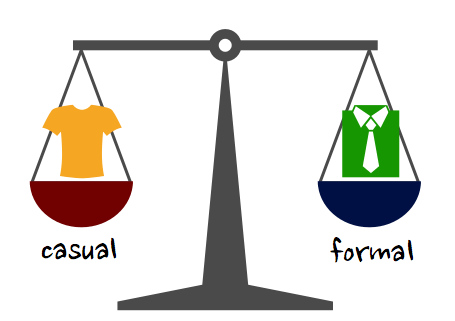
Register as Formality Scale:
- Frozen: Printed unchanging language, such as Biblical quotations, often contains archaisms.
- Formal: One-way participation; no interruption; technical vocabulary or exact definitions are important; includes presentations or introductions between strangers.
- Consultative: two-way participation; background information is provided – prior knowledge is not assumed. “Back-channel behavior” such as “uh huh”, “I see”, etc. is common. Interruptions are allowed. Examples include teacher/student, doctor/patient, expert/apprentice, etc.
- Casual: In-group friends and acquaintances; no background information provided; ellipsis and slang common; interruptions common. This is common among friends in a social setting.
- Intimate: Non-public; intonation more important than wording or grammar; private vocabulary. Also includes non-verbal messages. This is most common among family members and close friends.
LATINATE vs. GERMANIC DICTION:
Modern English is derived from Anglo-Saxon and Old English, both of which are Germanic in grammar, structure, and vocabulary. But around 1100 A.D., English saw an influx of words from French, which is a romance language (i.e., derived from Latin). In other words, English is a mixed up tongue! Often we find pairs of words, near synonyms, of which one comes from an Anglo-Saxon root and one from a Latinate root: e.g. kingly (Germanic), royal (from French roi), and regal (from Latin rex, regis).
As a (very rough) general rule, words derived from the Germanic are shorter, more concrete, and more direct. By contrast, Latinate words are generally longer, more abstract, and more formal sounding. Most of our vulgarities are of Anglo-Saxon ancestry: compare, for instance, shit (Germanic) with excrement (Latinate).
Latin/French based Anglo-Saxon/Germanic based
to investigate to check out
to renounce to give up
to liberate to free
to abbreviate to shorten
putrefaction rot
deficiency lack
residence home
perspiration sweat
infantile childish
vivacious lively
subsequently next/later
consequently so
THE DEMOTIC & THE POETIC
THE DEMOTIC
1. relating to the ordinary, everyday, current form of a language; vernacular:
2. relating to the common people.
SYNONYMS: popular, vernacular, colloquial, idiomatic, vulgar, common; informal, everyday, slangy
A demotic saying or expression is casual, colloquial, and used by the masses. Demotic comes from the Greek word demotikos, meaning “of or for the common people” or “in common use.” Members of the aristocracy don’t typically use demotic idioms, but it is often the elite who will point out that something is demotic.
THE POETIC
1. of, relating to, or used in poetry.
2. written in verse rather than prose.
3. having an imaginative or sensitively emotional style of expression.
SYNONYMS: expressive, figurative, symbolic, flowery, artistic, elegant, fine, beautiful; sensitive, imaginative, creative
Anything poetic either relates to the art of poetry or has the romantic aura of poetic imagery. A great speech can be poetic. An orange-red sunset at the beach can also be poetic. The word poetic comes from the Greek poietikos for “pertaining to poetry.” A poetic drama is one written in verse. Anything romantic or lyrical is also poetic. A painter’s use of colors could be poetic.
From “Preface to Lyrical Ballads” (1802) by William Wordsworth
There will also be found in these volumes little of what is usually called poetic diction; I have taken as much pains to avoid it as others ordinarily take to produce it; this I have done for the reason already alleged, to bring my language near to the language of men, and further, because the pleasure which I have proposed to myself to impart is of a kind very different from that which is supposed by many persons to be the proper object of poetry. […] The principal object, which I proposed to myself in these Poems was to choose incidents and situations from common life, and to relate or describe them, throughout, as far as was possible, in a selection of language really used by men […] Low and rustic life was generally chosen, because in that condition, the essential passions of the heart find a better soil in which they can attain their maturity, are less under restraint, and speak a plainer and more emphatic language; because in that condition of life our elementary feelings co-exist in a state of greater simplicity, and, consequently, may be more accurately contemplated, and more forcibly communicated; because the manners of rural life germinate from those elementary feelings; and, from the necessary character of rural occupations, are more easily comprehended, and are more durable; and lastly, because in that condition the passions of men are incorporated with the beautiful and permanent forms of nature. The language, too, of these men is adopted […] because such men hourly communicate with the best objects from which the best part of language is originally derived; and because, from their rank in society and the sameness and narrow circle of their intercourse, being less under the influence of social vanity they convey their feelings and notions in simple and unelaborated expressions. Accordingly, such a language, arising out of repeated experience and regular feelings, is a more permanent, and a far more philosophical language, than that which is frequently substituted for it by Poets, who think that they are conferring honor upon themselves and their art, in proportion as they separate themselves from the sympathies of men, and indulge in arbitrary and capricious habits of expression, in order to furnish food for fickle tastes, and fickle appetites, of their own creation.
 Street Poetry