
Audio for Rankine’s Citizen, parts I-III
I
When you are alone and too tired even to turn on any of your devices, you let yourself linger in a past stacked among your pillows. Usually you are nestled under blankets and the house is empty. Sometimes the moon is missing and beyond the windows the low, gray ceiling seems approachable. Its dark light dims in degrees depending on the density of clouds and you fall back into that which gets reconstructed as metaphor.
The route is often associative. You smell good. You are twelve attending Sts. Philip and James School on White Plains Road and the girl sitting in the seat behind asks you to lean to the right during exams so she can copy what you have written. Sister Evelyn is in the habit of taping the 100s and the failing grades to the coat closet doors. The girl is Catholic with waist-length brown hair. You can’t remember her name: Mary? Catherine?
You never really speak except for the time she makes her request and later when she tells you you smell good and have features more like a white person. You assume she thinks she is thanking you for letting her cheat and feels better cheating from an almost white person.
~
Sister Evelyn never figures out your arrangement perhaps because you never turn around to copy Mary Catherine’s answers. Sister Evelyn must think these two girls think a lot alike or she cares less about cheating and more about humiliation or she never actually saw you sitting there.
~

Title: Jim Crow Rd.
Date: 2008
Certain moments send adrenaline to the heart, dry out the tongue, and clog the lungs. Like thunder they drown you in sound, no, like lightning they strike you across the larynx. Cough. After it happened I was at a loss for words. Haven’t you said this yourself? Haven’t you said this to a close friend who early in your friendship, when distracted, would call you by the name of her black housekeeper? You assumed you two were the only black people in her life. Eventually she stopped doing this, though she never acknowledged her slippage. And you never called her on it (why not?) and yet, you don’t forget. If this were a domestic tragedy, and it might well be, this would be your fatal flaw—your memory, vessel of your feelings. Do you feel hurt because it’s the “all black people look the same” moment, or because you are being confused with another after being so close to this other?
~
An unsettled feeling keeps the body front and center. The wrong words enter your day like a bad egg in your mouth and puke runs down your blouse, a dampness drawing your stomach in toward your rib cage. When you look around only you remain. Your own disgust at what you smell, what you feel, doesn’t bring you to your feet, not right away, because gathering energy has become its own task, needing its own argument. You are reminded of a conversation you had recently, comparing the merits of sentences constructed implicitly with “yes, and” rather than “yes, but.” You and your friend decided that “yes, and” attested to a life with no turn-off, no alternative routes: you pull yourself to standing, soon enough the blouse is rinsed, it’s another week, the blouse is beneath your sweater, against your skin, and you smell good.
~
The rain this morning pours from the gutters and everywhere else it is lost in the trees. You need your glasses to single out what you know is there because doubt is inexorable; you put on your glasses. The trees, their bark, their leaves, even the dead ones, are more vibrant wet. Yes, and it’s raining. Each moment is like this—before it can be known, categorized as similar to another thing and dismissed, it has to be experienced, it has to be seen. What did he just say? Did she really just say that? Did I hear what I think I heard? Did that just come out of my mouth, his mouth, your mouth? The moment stinks. Still you want to stop looking at the trees. You want to walk out and stand among them. And as light as the rain seems, it still rains down on you.
~
You are in the dark, in the car, watching the black-tarred street being swallowed by speed; he tells you his dean is making him hire a person of color when there are so many great writers out there.
You think maybe this is an experiment and you are being tested or retroactively insulted or you have done something that communicates this is an okay conversation to be having.
Why do you feel comfortable saying this to me? You wish the light would turn red or a police siren would go off so you could slam on the brakes, slam into the car ahead of you, fly forward so quickly both your faces would suddenly be exposed to the wind.
As usual you drive straight through the moment with the expected backing off of what was previously said. It is not only that confrontation is headache-producing; it is also that you have a destination that doesn’t include acting like this moment isn’t inhabitable, hasn’t happened before, and the before isn’t part of the now as the night darkens and the time shortens between where we are and where we are going.
~
When you arrive in your driveway and turn off the car, you remain behind the wheel another ten minutes. You fear the night is being locked in and coded on a cellular level and want time to function as a power wash. Sitting there staring at the closed garage door you are reminded that a friend once told you there exists the medical term—John Henryism—for people exposed to stresses stemming from racism. They achieve themselves to death trying to dodge the buildup of erasure. Sherman James, the researcher who came up with the term, claimed the physiological costs were high. You hope by sitting in silence you are bucking the trend.
~
Because of your elite status from a year’s worth of travel, you have already settled into your window seat on United Airlines, when the girl and her mother arrive at your row. The girl, looking over at you, tells her mother, these are our seats, but this is not what I expected. The mother’s response is barely audible—I see, she says. I’ll sit in the middle.
~
A woman you do not know wants to join you for lunch. You are visiting her campus. In the café you both order the Caesar salad. This overlap is not the beginning of anything because she immediately points out that she, her father, her grandfather, and you, all attended the same college. She wanted her son to go there as well, but because of affirmative action or minority something—she is not sure what they are calling it these days and weren’t they supposed to get rid of it?—her son wasn’t accepted. You are not sure if you are meant to apologize for this failure of your alma mater’s legacy program; instead you ask where he ended up. The prestigious school she mentions doesn’t seem to assuage her irritation. This exchange, in effect, ends your lunch. The salads arrive.
~
A friend argues that Americans battle between the “historical self” and the “self self.” By this she means you mostly interact as friends with mutual interest and, for the most part, compatible personalities; however, sometimes your historical selves, her white self and your black self, or your white self and her black self, arrive with the full force of your American positioning. Then you are standing face-to-face in seconds that wipe the affable smiles right from your mouths. What did you say? Instantaneously your attachment seems fragile, tenuous, subject to any transgression of your historical self. And though your joined personal histories are supposed to save you from misunderstandings, they usually cause you to understand all too well what is meant.
~
You and your partner go to see the film The House We Live In. You ask a friend to pick up your child from school. On your way home your phone rings. Your neighbor tells you he is standing at his window watching a menacing black guy casing both your homes. The guy is walking back and forth talking to himself and seems disturbed.
You tell your neighbor that your friend, whom he has met, is babysitting. He says, no, it’s not him. He’s met your friend and this isn’t that nice young man. Anyway, he wants you to know, he’s called the police.
Your partner calls your friend and asks him if there’s a guy walking back and forth in front of your home. Your friend says that if anyone were outside he would see him because he is standing outside. You hear the sirens through the speakerphone.
Your friend is speaking to your neighbor when you arrive home. The four police cars are gone. Your neighbor has apologized to your friend and is now apologizing to you. Feeling somewhat responsible for the actions of your neighbor, you clumsily tell your friend that the next time he wants to talk on the phone he should just go in the backyard. He looks at you a long minute before saying he can speak on the phone wherever he wants. Yes, of course, you say. Yes, of course.
~
When the stranger asks, Why do you care? you just stand there staring at him. He has just referred to the boisterous teenagers in Starbucks as niggers. Hey, I am standing right here, you responded, not necessarily expecting him to turn to you.
He is holding the lidded paper cup in one hand and a small paper bag in the other. They are just being kids. Come on, no need to get all KKK on them, you say.
Now there you go, he responds.
The people around you have turned away from their screens. The teenagers are on pause. There I go? you ask, feeling irritation begin to rain down. Yes, and something about hearing yourself repeating this stranger’s accusation in a voice usually reserved for your partner makes you smile.
~
A man knocked over her son in the subway. You feel your own body wince. He’s okay, but the son of a bitch kept walking. She says she grabbed the stranger’s arm and told him to apologize: I told him to look at the boy and apologize. Yes, and you want it to stop, you want the child pushed to the ground to be seen, to be helped to his feet, to be brushed off by the person that did not see him, has never seen him, has perhaps never seen anyone who is not a reflection of himself.
The beautiful thing is that a group of men began to stand behind me like a fleet of bodyguards, she says, like newly found uncles and brothers.
~
The new therapist specializes in trauma counseling. You have only ever spoken on the phone. Her house has a side gate that leads to a back entrance she uses for patients. You walk down a path bordered on both sides with deer grass and rosemary to the gate, which turns out to be locked.
At the front door the bell is a small round disc that you press firmly. When the door finally opens, the woman standing there yells, at the top of her lungs, Get away from my house! What are you doing in my yard?
It’s as if a wounded Doberman pinscher or a German shepherd has gained the power of speech. And though you back up a few steps, you manage to tell her you have an appointment. You have an appointment? she spits back. Then she pauses. Everything pauses. Oh, she says, followed by, oh, yes, that’s right. I am sorry.
I am so sorry, so, so sorry.

Kate Clark
Title: Little Girl, 2008
infant caribou hide, foam, clay, pins, thread, rubber eyes
II
Hennessy Youngman aka Jayson Musson, whose Art Thoughtz take the form of tutorials on YouTube, educates viewers on contemporary art issues. In one of his many videos, he addresses how to become a successful black artist, wryly suggesting black people’s anger is marketable. He advises black artists to cultivate “an angry nigger exterior” by watching, among other things, the Rodney King video while working.

Screen grab from ART THOUGHTZ: How to Be a Successful Black Artist
Courtesy of Jayson Musson
http://www.youtube.com/watch?v=3L_NnX8oj-g
Youngman’s suggestions are meant to expose expectations for blackness as well as to underscore the difficulty inherent in any attempt by black artists to metabolize real rage. The commodified anger his video advocates rests lightly on the surface for spectacle’s sake. It can be engaged or played like the race card and is tied solely to the performance of blackness and not to the emotional state of particular individuals in particular situations.
On the bridge between this sellable anger and “the artist” resides, at times, an actual anger. Youngman in his video doesn’t address this type of anger: the anger built up through experience and the quotidian struggles against dehumanization every brown or black person lives simply because of skin color. This other kind of anger in time can prevent, rather than sponsor, the production of anything except loneliness.
You begin to think, maybe erroneously, that this other kind of anger is really a type of knowledge: the type that both clarifies and disappoints. It responds to insult and attempted erasure simply by asserting presence, and the energy required to present, to react, to assert is accompanied by visceral disappointment: a disappointment in the sense that no amount of visibility will alter the ways in which one is perceived.
Recognition of this lack might break you apart. Or recognition might illuminate the erasure the attempted erasure triggers. Whether such discerning creates a healthier, if more isolated, self, you can’t know. In any case, Youngman doesn’t speak to this kind of anger. He doesn’t say that witnessing the expression of this more ordinary and daily anger might make the witness believe that a person is “insane.”
And insane is what you think, one Sunday afternoon, drinking an Arnold Palmer, watching the 2009 Women’s US Open final, when brought to full attention by the suddenly explosive behavior of Serena Williams. Serena in HD before your eyes becomes overcome by a rage you recognize and have been taught to hold at a distance for your own good. Serena’s behavior, on this particular Sunday afternoon, suggests that all the injustice she has played through all the years of her illustrious career flashes before her and she decides finally to respond to all of it with a string of invectives. Nothing, not even the repetition of negations (“no, no, no”) she employed in a similar situation years before as a younger player at the 2004 US Open, prepares you for this. Oh my God, she’s gone crazy, you say to no one.
What does a victorious or defeated black woman’s body in a historically white space look like? Serena and her big sister Venus Williams brought to mind Zora Neale Hurston’s “I feel most colored when I am thrown against a sharp white background.” This appropriated line, stenciled on canvas by Glenn Ligon, who used plastic letter stencils, smudging oil sticks, and graphite to transform the words into abstractions, seemed to be ad copy for some aspect of life for all black bodies.
Hurston’s statement has been played out on the big screen by Serena and Venus: they win sometimes, they lose sometimes, they’ve been injured, they’ve been happy, they’ve been sad, ignored, booed mightily (see Indian Wells, which both sisters have boycotted since 2001), they’ve been cheered, and through it all and evident to all were those people who are enraged they are there at all—graphite against a sharp white background.
For years you attribute to Serena Williams a kind of resilience appropriate only for those who exist in celluloid. Neither her father nor her mother nor her sister nor Jehovah her God nor NIKE camp could shield her ultimately from people who felt her black body didn’t belong on their court, in their world. From the start many made it clear Serena would have done better struggling to survive in the two-dimensionality of a Millet painting, rather than on their tennis court—better to put all that strength to work in their fantasy of her working the land, rather than be caught up in the turbulence of our ancient dramas, like a ship fighting a storm in a Turner seascape.
The most notorious of Serena’s detractors takes the form of Mariana Alves, the distinguished tennis chair umpire. In 2004 Alves was excused from officiating any more matches on the final day of the US Open after she made five bad calls against Serena in her semifinal matchup against fellow American Jennifer Capriati. The serves and returns Alves called out were landing, stunningly un returned by Capriati, inside the lines, no discerning eyesight needed. Commentators, spectators, television viewers, line judges, everyone could see the balls were good, everyone, apparently, except Alves. No one could understand what was happening. Serena, in her denim skirt, black sneaker boots, and dark mascara, began wagging her finger and saying “no, no, no,” as if by negating the moment she could propel us back into a legible world. Tennis superstar John McEnroe, given his own keen eye for injustice during his professional career, was shocked that Serena was able to hold it together after losing the match.
Though no one was saying anything explicitly about Serena’s black body, you are not the only viewer who thought it was getting in the way of Alves’s sight line. One commentator said he hoped he wasn’t being unkind when he stated, “Capriati wins it with the help of the umpires and the lines judges.” A year later that match would be credited for demonstrating the need for the speedy installation of Hawk-Eye, the line-calling technology that took the seeing away from the beholder. Now the umpire’s call can be challenged by a replay; however, back then after the match Serena said, “I’m very angry and bitter right now. I felt cheated. Shall I go on? I just feel robbed.”
And though you felt outrage for Serena after that 2004 US Open, as the years go by, she seems to put Alves, and a lengthening list of other curious calls and oversights, against both her and her sister, behind her as they happen.
Yes, and the body has memory. The physical carriage hauls more than its weight. The body is the threshold across which each objectionable call passes into consciousness—all the unintimidated, unblinking, and unflappable resilience does not erase the moments lived through, even as we are eternally stupid or everlastingly optimistic, so ready to be inside, among, a part of the games.
And here Serena is, five years after Alves, back at the US Open, again in a semifinal match, this time against Belgium’s Kim Clijsters. Serena is not playing well and loses the first set. In response she smashes her racket on the court. Now McEnroe isn’t stunned by her ability to hold herself together and is moved to say, “That’s as angry as I’ve ever seen her.” The umpire gives her a warning; another violation will mean a point penalty.
She is in the second set at the critical moment of 5–6 in Clijsters’s favor, serving to stay in the match, at match point. The line judge employed by the US Open to watch Serena’s body, its every move, says Serena stepped on the line while serving. What? (The Hawk-Eye cameras don’t cover the feet, only the ball, apparently.) What! Are you serious? She is serious; she has seen a foot fault, one no one else is able to locate despite the numerous replays. “No foot fault, you definitely do not see a foot fault there,” says McEnroe. “That’s overofficiating for certain,” says another commentator. Even the ESPN tennis commentator, who seems predictable in her readiness to find fault with the Williams sisters, says, “Her foot fault call was way off.” Yes, and even if there had been a foot fault, despite the rule, they are rarely ever called at critical moments in a Grand Slam match because “You don’t make a call,” tennis official Carol Cox says, “that can decide a match unless it’s flagrant.”
As you look at the affable Kim Clijsters, you try to entertain the thought that this scenario could have played itself out the other way. And as Serena turns to the lineswoman and says, “I swear to God I’m fucking going to take this fucking ball and shove it down your fucking throat, you hear that? I swear to God!” As offensive as her outburst is, it is difficult not to applaud her for reacting immediately to being thrown against a sharp white background. It is difficult not to applaud her for existing in the moment, for fighting crazily against the so-called wrongness of her body’s positioning at the service line.
She says in 2009, belatedly, the words that should have been said to the umpire in 2004, the words that might have snapped Alves back into focus, a focus that would have acknowledged what actually was happening on the court. Now Serena’s reaction is read as insane. And her punishment for this moment of manumission is the threatened point penalty resulting in the loss of the match, an $82,500 fine, plus a two-year probationary period by the Grand Slam Committee.
Perhaps the committee’s decision is only about context, though context is not meaning. It is a public event being watched in homes across the world. In any case, it is difficult not to think that if Serena lost context by abandoning all rules of civility, it could be because her body, trapped in a racial imaginary, trapped in disbelief—code for being black in America—is being governed not by the tennis match she is participating in but by a collapsed relationship that had promised to play by the rules. Perhaps this is how racism feels no matter the context—randomly the rules everyone else gets to play by no longer apply to you, and to call this out by calling out “I swear to God!” is to be called insane, crass, crazy. Bad sportsmanship.
Two years later, September 11, 2011, Serena is playing the Australian Sam Stosur in the US Open final. She is expected to win, having just beaten the number-one player, the Dane Caroline Wozniacki, in the semifinal the night before. Some speculate Serena especially wants to win this Grand Slam because it is the tenth anniversary of the attack on the Twin Towers. It’s believed that by winning she will prove her red-blooded American patriotism and will once and for all become beloved by the tennis world (think Arthur Ashe after his death). All the bad calls, the boos, the criticisms that she has made ugly the game of tennis—through her looks as well as her behavior—that entire cluster of betrayals will be wiped clean with this win.
One imagines her wanting to say what her sister would say a year later after being diagnosed with Sjögren’s syndrome and losing her match to shouts of “Let’s go, Venus!” in Arthur Ashe Stadium: “I know this is not proper tennis etiquette, but this is the first time I’ve ever played here that the crowd has been behind me like that. Today I felt American, you know, for the first time at the US Open. So I’ve waited my whole career to have this moment and here it is.”
It is all too exhausting and Serena’s exhaustion shows in her playing; she is losing, a set and a game down. Yes, and finally she hits a great shot, a big forehand, and before the ball is safely past Sam Stosur’s hitting zone, Serena yells, “Come on!” thinking she has hit an irretrievable winner. The umpire, Eva Asderaki, rules correctly that Serena, by shouting, interfered with Stosur’s concentration. Subsequently, a ball that Stosur seemingly would not have been able to return becomes Stosur’s point. Serena’s reply is to ask the umpire if she is trying to screw her again. She remembers the umpire doing this to her before. As a viewer, you too, along with John McEnroe, begin to wonder if this is the same umpire from 2004 or 2009. It isn’t—in 2004 it was Mariana Alves and in 2009 it was Sharon Wright; however, the use of the word “again” by Serena returns her viewers to other times calling her body out.
Again Serena’s frustrations, her disappointments, exist within a system you understand not to try to understand in any fair-minded way because to do so is to understand the erasure of the self as systemic, as ordinary. For Serena, the daily diminishment is a low flame, a constant drip. Every look, every comment, every bad call blossoms out of history, through her, onto you. To understand is to see Serena as hemmed in as any other black body thrown against our American background. “Aren’t you the one that screwed me over last time here?” she asks umpire Asderaki. “Yeah, you are. Don’t look at me. Really, don’t even look at me. Don’t look my way. Don’t look my way,” she repeats, because it is that simple.
Yes, and who can turn away? Serena is not running out of breath. Despite all her understanding, she continues to serve up aces while smashing rackets and fraying hems. In the 2012 Olympics she brought home the only two gold medals the Americans would win in tennis. After her three-second celebratory dance on center court at the All England Club, the American media reported, “And there was Serena … Crip-Walking all over the most lily-white place in the world…. You couldn’t help but shake your head…. What Serena did was akin to cracking a tasteless, X-rated joke inside a church…. What she did was immature and classless.”
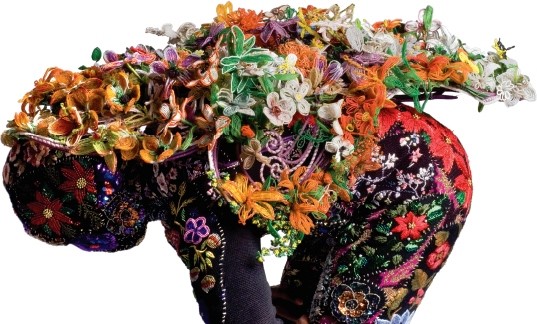
Title: Soundsuits
Photo by James Prinz
Before making the video How to Be a Successful Black Artist, Hennessy Youngman uploaded to YouTube How to Be a Successful Artist. While putting forward the argument that one needs to be white to be truly successful, he adds, in an aside, that this might not work for blacks because if “a nigger paints a flower it becomes a slavery flower, flower de Amistad,” thereby intimating that any relationship between the white viewer and the black artist immediately becomes one between white persons and black property, which was the legal state of things once upon a time, as Patricia Williams has pointed out in The Alchemy of Race and Rights: “The cold game of equality staring makes me feel like a thin sheet of glass…. I could force my presence, the real me contained in those eyes, upon them, but I would be smashed in the process.”
Interviewed by the Brit Piers Morgan after her 2012 Olympic victory, Serena is informed by Morgan that he was planning on calling her victory dance “the Serena Shuffle”; however, he has learned from the American press that it is a Crip Walk, a gangster dance. Serena responds incredulously by asking if she looks like a gangster to him. Yes, he answers. All in a day’s fun, perhaps, and in spite and despite it all, Serena Williams blossoms again into Serena Williams. When asked if she is confident she can win her upcoming matches, her answer remains, “At the end of the day, I am very happy with me and I’m very happy with my results.”
Serena would go on to win every match she played between the US Open and the year-end 2012 championship tournament, and because tennis is a game of adjustments, she would do this without any reaction to a number of questionable calls. More than one commentator would remark on her ability to hold it together during these matches. She is a woman in love, one suggests. She has grown up, another decides, as if responding to the injustice of racism is childish and her previous demonstration of emotion was free-floating and detached from any external actions by others. Some others theorize she is developing the admirable “calm and measured logic” of an Arthur Ashe, who the sportswriter Bruce Jenkins felt was “dignified” and “courageous” in his ability to confront injustice without making a scene. Jenkins, perhaps inspired by Serena’s new comportment, felt moved to argue that her continued boycott of Indian Wells in 2013, where she felt traumatized by the aggression of racist slurs hurled at her in 2001, was lacking in “dignity” and “integrity” and demonstrated “only stubbornness and a grudge.”
Watching this newly contained Serena, you begin to wonder if she finally has given up wanting better from her peers or if she too has come across Hennessy’s Art Thoughtz and is channeling his assertion that the less that is communicated the better. Be ambiguous. This type of ambiguity could also be diagnosed as dissociation and would support Serena’s claim that she has had to split herself off from herself and create different personae.
Now that there is no calling out of injustice, no yelling, no cursing, no finger wagging or head shaking, the media decides to take up the mantle when on December 12, 2012, two weeks after Serena is named WTA Player of the Year, the Dane Caroline Wozniacki, a former number-one player, imitates Serena by stuffing towels in her top and shorts, all in good fun, at an exhibition match. Racist? CNN wants to know if outrage is the proper response.
It’s then that Hennessy’s suggestions about “how to be a successful artist” return to you: be ambiguous, be white. Wozniacki, it becomes clear, has finally enacted what was desired by many of Serena’s detractors, consciously or unconsciously, the moment the Compton girl first stepped on court. Wozniacki (though there are a number of ways to interpret her actions—playful mocking of a peer, imitation of the mimicking antics of the tennis player known as the joker, Novak Djokovic) finally gives the people what they have wanted all along by embodying Serena’s attributes while leaving Serena’s “angry nigger exterior” behind. At last, in this real, and unreal, moment, we have Wozniacki’s image of smiling blond goodness posing as the best female tennis player of all time.

Date: December 7, 2012
Collection: AFP
Credit: AFP/Getty Images
III
You are rushing to meet a friend in a distant neighborhood of Santa Monica. This friend says, as you walk toward her, You are late, you nappy-headed ho. What did you say? you ask, though you have heard every word. This person has never before referred to you like this in your presence, never before code-switched in this manner. What did you say? She doesn’t, perhaps physically cannot, repeat what she has just said.
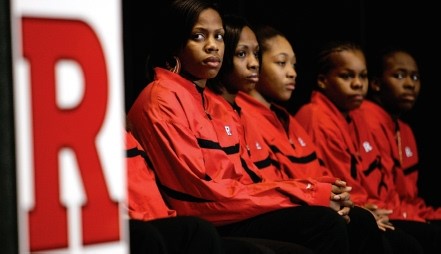
Date photographed: April 10, 2007
Credit: MIKE SEGAR/Reuters/Corbis
Maybe the content of her statement is irrelevant and she only means to signal the stereotype of “black people time” by employing what she perceives to be “black people language.” Maybe she is jealous of whoever kept you and wants to suggest you are nothing or everything to her. Maybe she wants to have a belated conversation about Don Imus and the women’s basketball team he insulted with this language. You don’t know. You don’t know what she means. You don’t know what response she expects from you nor do you care. For all your previous understandings, suddenly incoherence feels violent. You both experience this cut, which she keeps insisting is a joke, a joke stuck in her throat, and like any other injury, you watch it rupture along its suddenly exposed suture.
~
When a woman you work with calls you by the name of another woman you work with, it is too much of a cliché not to laugh out loud with the friend beside you who says, oh no she didn’t. Still, in the end, so what, who cares? She had a fifty-fifty chance of getting it right.
Yes, and in your mail the apology note appears referring to “our mistake.” Apparently your own invisibility is the real problem causing her confusion. This is how the apparatus she propels you into begins to multiply its meaning.
What did you say?
~
At the end of a brief phone conversation, you tell the manager you are speaking with that you will come by his office to sign the form. When you arrive and announce yourself, he blurts out, I didn’t know you were black!
I didn’t mean to say that, he then says.
Aloud, you say.
What? he asks.
You didn’t mean to say that aloud.
Your transaction goes swiftly after that.
~
And when the woman with the multiple degrees says, I didn’t know black women could get cancer, instinctively you take two steps back though all urgency leaves the possibility of any kind of relationship as you realize nowhere is where you will get from here.
~
A friend tells you he has seen a photograph of you on the Internet and he wants to know why you look so angry. You and the photographer chose the photograph he refers to because you both decided it looked the most relaxed. Do you look angry? You wouldn’t have said so. Obviously this unsmiling image of you makes him uncomfortable, and he needs you to account for that.
If you were smiling, what would that tell him about your composure in his imagination?
~
Despite the fact that you have the same sabbatical schedule as everyone else, he says, you are always on sabbatical. You are friends so you respond, easy.
What do you mean?
Exactly, what do you mean?
~
Someone in the audience asks the man promoting his new book on humor what makes something funny. His answer is what you expect—context. After a pause he adds that if someone said something, like about someone, and you were with your friends you would probably laugh, but if they said it out in public where black people could hear what was said, you might not, probably would not. Only then do you realize you are among “the others out in public” and not among “friends.”
~
Not long ago you are in a room where someone asks the philosopher Judith Butler what makes language hurtful. You can feel everyone lean in. Our very being exposes us to the address of another, she answers. We suffer from the condition of being addressable. Our emotional openness, she adds, is carried by our addressability. Language navigates this.
For so long you thought the ambition of racist language was to denigrate and erase you as a person. After considering Butler’s remarks, you begin to understand yourself as rendered hypervisible in the face of such language acts. Language that feels hurtful is intended to exploit all the ways that you are present. Your alertness, your openness, and your desire to engage actually demand your presence, your looking up, your talking back, and, as insane as it is, saying please.
~
Standing outside the conference room, unseen by the two men waiting for the others to arrive, you hear one say to the other that being around black people is like watching a foreign film without translation. Because you will spend the next two hours around the round table that makes conversing easier, you consider waiting a few minutes before entering the room.
~
The real estate woman, who didn’t fathom she could have made an appointment to show her house to you, spends much of the walk-through telling your friend, repeatedly, how comfortable she feels around her. Neither you nor your friend bothers to ask who is making her feel uncomfortable.
~
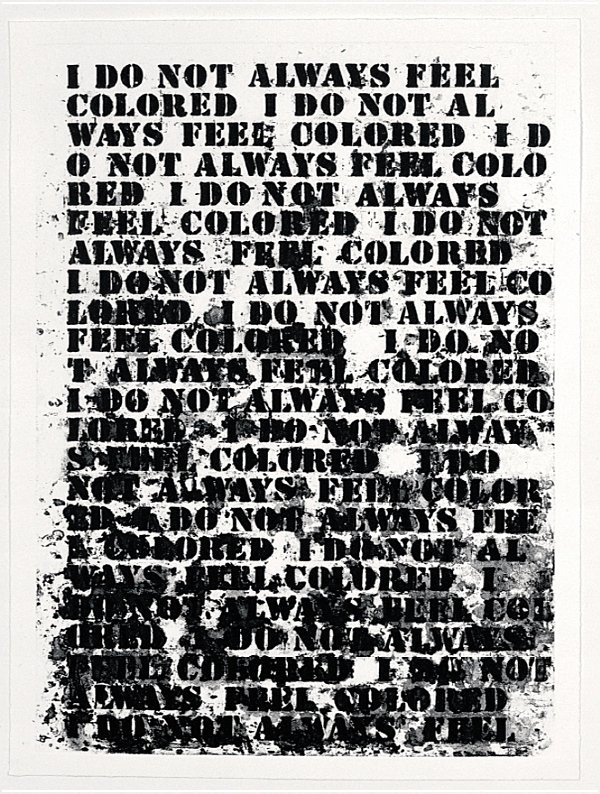
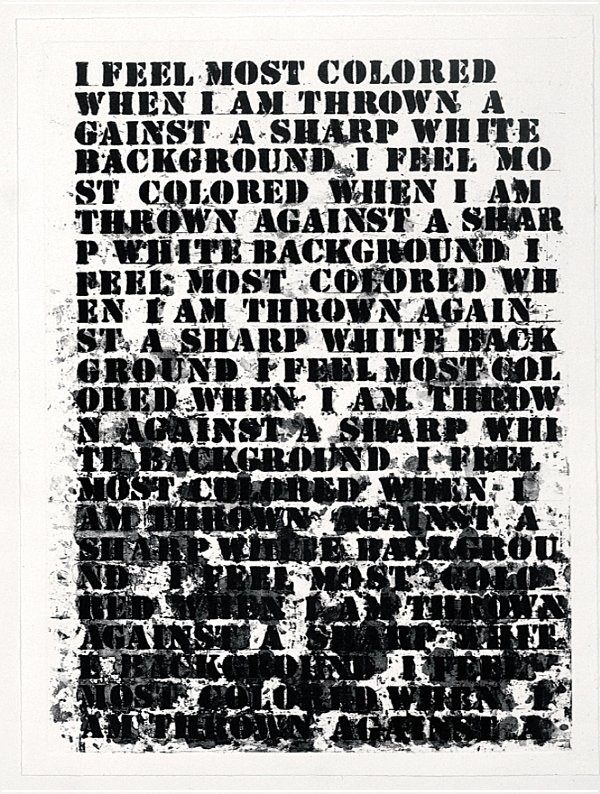
Title: Untitled (I Feel Most Colored When I Am Thrown Against a Sharp White Background), 1990–91
oilstick and gesso on panel
80 × 30 inches
The man at the cash register wants to know if you think your card will work. If this is his routine, he didn’t use it on the friend who went before you. As she picks up her bag, she looks to see what you will say. She says nothing. You want her to say something—both as witness and as a friend. She is not you; her silence says so. Because you are watching all this take place even as you participate in it, you say nothing as well. Come over here with me, your eyes say. Why on earth would she? The man behind the register returns your card and places the sandwich and Pellegrino in a bag, which you take from the counter. What is wrong with you? This question gets stuck in your dreams.
~
Another friend tells you you have to learn not to absorb the world. She says sometimes she can hear her own voice saying silently to whomever—you are saying this thing and I am not going to accept it. Your friend refuses to carry what doesn’t belong to her.
You take in things you don’t want all the time. The second you hear or see some ordinary moment, all its intended targets, all the meanings behind the retreating seconds, as far as you are able to see, come into focus. Hold up, did you just hear, did you just say, did you just see, did you just do that? Then the voice in your head silently tells you to take your foot off your throat because just getting along shouldn’t be an ambition.
 Street Poetry