signifyin(g)
• definition: “the rhetorical principle in Afro-American vernacular discourse,” a rhetorical practice that involves
• elements: repetition and difference, besting, boasting, outlaw heroics
• interest: competition, drive to eloquence, humor, wit, self-affirmation, self-definition
• examples: the dozens, the toasts, battle rap
o related words and terms: signifyin(g), signification, persona, alternative self, contestation, competition, provocation, boastfulness, outdoing, drive towards eloquence, insult, diss, dissing, verbal jabbing, diminishment, wit, braggadocio, ostentatious punning, pugilistic, narcissism, vulnerability, self-exploration, self-expression, self-exaltation, self-recuperation, celebration of self, defensiveness, denigration of others, swagger, confidence, brashness, assuredness, rhetoric, boasting, besting, “the dozens,” “the toasts,” heroics, kenning, claims to artistry/intellect/skill, claims to wealth/strength/sexual prowess, claims to truthfulness/authenticity, etc.
related to signifying
• the dozens: a ritualized game typically engaged in by two persons each of whom attempts to outdo the other in insults directed against members of the other’s family (usually used in the phrase play the dozens).
• the toasts: lengthy, recited narratives or poems describing a series of exploits by a central character, especially an outlaw hero
BLACK VERNACULAR TRADITION
HISTORICAL ORIGINS
Prior to the end of slavery in the United States, white slaveholders generally limited or outright prohibited the education of enslaved African Americans, because they feared such learning might empower their chattel and inspire or enable emancipatory ambitions. In the United States, the legislation that denied slaves formal education likely contributed to their maintaining a strong oral tradition, a common feature of indigenous African cultures. African-based oral traditions became the primary means of preserving history, mores, and other cultural information among the people. This was consistent with the griot practices of oral history in many African and other cultures that did not rely on the written word. Many of these cultural elements have been passed from generation to generation through storytelling. The folktales provided African Americans the opportunity to inspire and educate one another, and black vernacular traditions and rhetorical techniques continue in a variety of forms.
SIGNIFYIN(G)
Signifyin(g) refers to a combination of rhetorical strategies employed in African American speech communities—in particular, the use of irony and indirection to express ideas and opinions. In The Signifying Monkey: A Theory of African-American Literary Criticism (Oxford Univ. Press, 1988), Henry Louis Gates describes signifyin(g) as “a trope in which are subsumed several other rhetorical tropes, including metaphor, metonymy, synecdoche, and irony (the master tropes), and also hyperbole, litotes, and metalepsis.”
Signifyin(g) is closely related to double-talk and trickery of the type used by the Signifying Monkey of these narratives, but, as Gates himself admits, “It is difficult to arrive at a consensus of definitions of signifyin(g).” Bernard W. Bell defines it as an “elaborate, indirect form of goading or insult generally making use of profanity.” Roger D. Abrahams writes that to signify is “to imply, goad, beg, boast by indirect verbal or gestural means.”
SOME PERSPECTIVES ON SIGNIFYING
- “Above all, signifying is
a ritualistic practice that serves various functions in different African
American discursive and communal spaces. Some scholars define signifying
as primarily a male-dominated activity (the female version is called
‘specifying’). African American men in this verbal art form focus their
anger, aggression, and frustration into a relatively harmless exchange of
wordplay where they can establish their masculinity in verbal ‘battles’
with their peers. This form of signifying lends itself to validating a
pecking order style of dominance based on the result of the verbal
exchange. . . .Signifying can affirm, critique, or build community through
the involvement of its participants.”
- Carole Boyce Davies, Encyclopedia of the African Diaspora: Origins, Experiences, and Culture. ABC-CLIO, 2008
- “Women, and to a certain extent
children, commonly use more indirect methods of signifying. These
range from the most obvious kinds of indirection, like using an unexpected
pronoun in discourse (‘Didn’t we come to shine today’ or ‘Who
thinks his drawers don’t stink?’), to the more subtle technique, of louding
or loud-talking in a different sense from the one
above. A person is loud-talking when he says something of someone just
loud enough for that person to hear, but indirectly, so he cannot properly
respond (Mitchell-Kernan). Another technique of signifying through
indirection is making reference to a person or group not present, in order
to start trouble between someone present and the ones who are not. An
example of this technique is the famous toast, ‘The Signifying Monkey.’
- Roger D. Abrahams, Talking Black. Newbury House, 1976
- “Rhetorically, for the African American
community, the strategy behind indirection suggests that direct
confrontation in everyday discourse is to be avoided when possible. . . .
Normally, indirection has been treated as a function of the speech
acts and not as a rhetorical strategy in oral discourse. Boasting,
bragging, loud talking, rapping, signifying, and, to a
degree, playing the dozens have elements of indirection. . .
. While signifying is a way of
encoding a message, one’s shared cultural knowledge is the basis on which
any reinterpretation of the message is made. Theoretically, signifying
(Black) as a concept can be used to give meaning to rhetorical acts of African
Americans and indicate a Black presence. Rhetorically, one can also
explore texts for the manner in which the themes or worldviews of other
texts are repeated and revised with a signal difference, but based on
shared knowledge.”
- Thurmon Garner and Carolyn Calloway-Thomas, “African American Orality.” Understanding African American Rhetoric: Classical Origins to Contemporary Innovations, ed. by Ronald L. Jackson II and Elaine B. Richardson. Routledge, 2003
THE DOZENS
The dozens are a game of put-downs: the rapid, ritualistic exchange of insults, often targeting family members. The rhetorical contest of playing or shooting the dozens (also known as capping, ranking, and sounding) is most commonly practiced by young African-American males.
Examples:
Your mama’s so FAT, after she got off the carousel, the horse limped for a week.
Mo’s rebuttal: Your mama’s so skinny, she can hula-hoop through a Froot Loop.
Your mama’s so FAT, her blood type is Ragu.
Mo’s rebuttal: Your mama’s so skinny, she looks like a mic stand.
Your mama’s so FAT, instead of 501 jeans she wears 1002s.
Mo’s rebuttal: Your mama’s so skinny, she turned sideways and disappeared.
Your mama’s so FAT she’s not on a diet she’s on a triet. What y’all eating? I’ll try it.
Mo’s rebuttal: Your mama’s so skinny, I gave her a piece of popcorn and she went into a coma.
Your mama’s so FAT, when she jumped in the air she got stuck.
Mo’s rebuttal: Your mama’s so skinny, you could blindfold her with dental floss.
(Mo’nique Imes and Sherry A. McGee, Skinny Women Are Evil: Notes of a Big Girl in a Small-Minded World. Atriz, 2004)
PERSPECTIVES ON THE DOZENS
- A Game of Insults
“The dozens is usually played by two young black males, often surrounded by an interested and encouraging audience of peers in which the players insult and provoke each other with put-downs of each other’s mother or other female family members. This process teaches one to take insults in stride while encouraging verbal retorts. . . . The dozens is played more often and more intensely in urban ghettos where frustrations are greater and the strategies of the ghetto are appropriate in a zero-sum game; neither player really wins. The dozens works when the players share a common ethnicity, a degree of connectedness, and acceptance of the activity for what it is—a game (Bruhn and Murray, 1985).”
John G. Bruhn, The Sociology of Community Connections. Kluwer Acacademic/Plenum, 2005
- A Rite of Passage
“Alan Dundes found that the social and artistic are infused in the Afrodiasporic practice of the dozens, which he notes functions both as an assertion of masculinity and as a rite of passage for the secular mastery of words. The dozens not only establishes a framework for verbal creativity; children also use them to determine a social hierarchy. A good dozens player not only cooly withstands merciless insults to his family; he also twists memorized insults quickly to suit the opponent at hand.”
Ali Colleen Neff, Let the World Listen Right: The Mississippi Delta Hip-Hop Story. University Press of Mississippi, 2009
- An Inoculation
“While retaining the form and spirit of the West African original, African-American dozens has elaborated the witty one-liners into complex verbal war games involving huge armories and modes of attack and defense undreamt of in the homeland. It is a case of Darwinian adaptation for survival of the species in the killing jungles of slavery and racism. The mother remains the central figure. By learning to deal with verbal abuse of her, the modern black youngster learns to endure the historical, real-life abuse. It is as if the system is inoculated with virtual (verbally imagined) strains of the virus, thereby gaining immunity and new health in spite of the reality on the ground.”
Onwuchekwa Jemie, Yo Mama! New Raps, Toasts, Dozens, Jokes, and Children’s Rhymes From Urban Black America.
THE TOASTS
Definition:
Toasts are stock tales that were generally recounted in rhyme. Most are bawdy, violent, highly stylized and funny. Toasts are performed narratives of often urban but always heroic events. For many African Americans, both performers and audience, hearing about or performing the winning ways of the central character becomes as creative a release as Black music. Many of the folkloric examples were collected in prisons, military contexts, barbershops, street corners, etc. As with the dozens, some trace their roots to West Africa. Some of the most famous examples are The Signifying Monkey, Stagger Lee (Stackolee), Mexicana Rose, The Freaks Ball, Doriella Du Fontaine, etc.
African American Vernacular English
AAVE is a variety of English spoken by many African-Americans in the USA which shares a set of grammatical and other linguistic features that distinguish it from various other American dialects. Morphological and syntactic features of AAVE grammar include:
- Existential it: AAVE speakers often use it as the empty subject where speakers of other dialects would use there, as in It’s some coffee in the kitchen. Often it’s pronounced as i’s.
- Absence of plural –s marking: For example, four girl. Not a very common feature overall. Based on a survey of existing studies, [John Russell] Rickford and [Russell John] Rickford report that –s absence occurs from 1 to 10 percent of the time.
- Absence of possessive –s marking: For example, at my mama house. Rickford and Rickford note that this feature is more frequent than plural –s absence, and report it occurring at a rate of over 50 percent in a number of studies.
- Absence of third person singular –s marking: For example, It seem like . . . or She have three kids. Rickford and Rickford report that this feature is very frequent, occurring at percentages that range from around 50 percent to up to 96 percent or 97 percent.
- Zero copula (either is or are): For example, She φ in the same grade. The first person singular copula (I am) cannot be deleted. Rickford and Rickford note that deletion is also very unusual in the forms it’s, that’s, and what’s, which tend to have a phonological process that deletes the [t] instead.
- Invariant (or habitual) be: As in Your phone bill be high, meaning “Your phone bill is usually or often high.” Most frequent with – ing forms as in He be getting on my nerves.
- Unstressed been: Similar to have been or has been in other dialects, as in I been playing cards since I was four.
- Stressed (remote-past or emphatic) BEEN: Indicates an action that has been true for a long time or is emphatically true. For example, She BEEN tell me that, meaning “She told me that a long time ago.”
- Completive done: an aspectmarker signaling completion, as in I done already finished that. Rickford and Rickford note that it may differ slightly from perfective forms in other dialects, in that speakers report that done has a higher degree of intensity.
- Future perfect be done: For example: I be done did your hair before you know it, meaning “I will have finished doing your hair before you know it.”
- Use of ain’t for negation: For example, I ain’t lyin’. This form is of course extremely common in dialects other than AAVE, as a variant for forms of isn’t or hasn’t. The usage that is more unique to AAVE is its alternation with didn’t, as in He ain’t go no further than third or fourth grade.
- Negative concord: For example, I don’t want nothing nobody can’t enjoy. Again, this feature (which may also be referred to as “multiple negation”) is common to other dialects as well. Negative inversion, though, seems to be more specifically characteristic of AAVE, as in Can’t nobody beat them.
- Preterite had: Use of had + past tense verb to refer to a simple past event, as in I had slipped and fell to mean “I slipped and fell.” (Rickford and Rickford suggest that preterite had may be age-graded, so that speakers stop using it as they get older.)
- Steady: Used to emphasize the intense or persistent nature of an action, as in Them students be steady trying to make a buck.
- Come: Used to express indignation, as in Don’t come acting like you don’t know what happened.
- Finna: Used to mark an action that is about to take place, as in I’m finna get up out of here, meaning “I’m about to leave.” Related to fixing to, used throughout the South.
Fought, Carmen. Language and Ethnicity: Key Topics in Sociolinguistics. Cambridge University Press, 2006. pp. 47-49
Dolemite Is My Name | Signifying Monkey | Way Down in the Jungle Deep
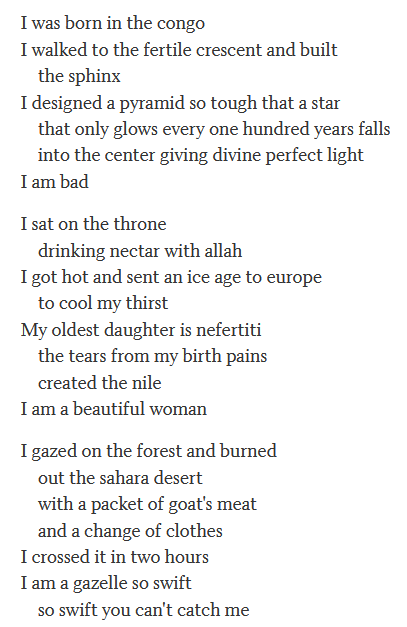
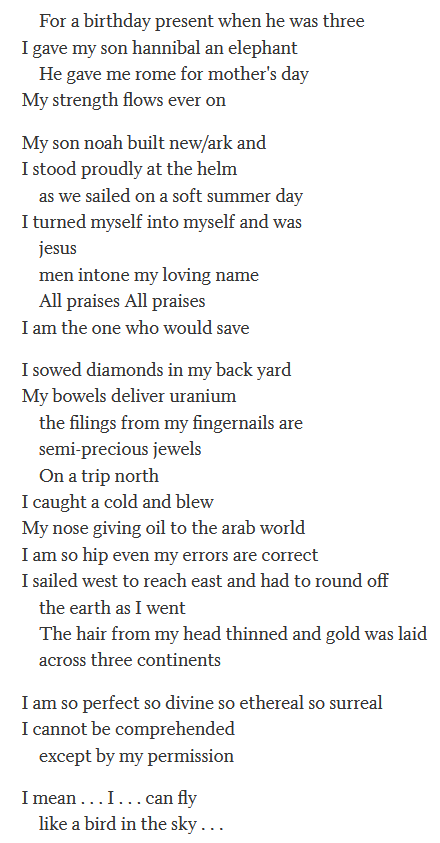
Nikki Giovanni – “Ego Tripping (there may be a reason why)
Jean Grae – “# 8” (2008)
[Edgar Allen Floe]
What up, Jean? You know there’s a lot of nonsense in the streets right now, you see it right? Tell ‘em whats up…
[Jean Grae]
Possibly I could, dropping some knowledge I should,
But I ain’t finish college and I’m not a Kanye, got it? Good.
Intelligent rhetoric, brain packed like a tenement.
Aimed back at the tenants, my face crack in a venomous rage.
I really wanna blaze all you, burn you like 8 whores do.
Hurl you like Florida storm furniture.
Permanent marker: Jean is tagging blacking up on your partner’s penis.
Pardon the phoenix I mark you plus I bark the meanest.
Hardly elitist, I know the struggle.
I mostly bubble underground like a soda below some broken rubble.
At ground zero, I get down, nigga, like them brown people.
Saturday Night just waiting Sonny Cheeba, lift ya.
I’ll levitate the scriptures just so I can see ‘em better.
Each and every letter was conceived by Jean. I’m the Coretta
Scott King of my day I mean, standing by my mate, my king,
Planning for Jamaica honeymooning, vacationing,
CD breaking in, skipping on this track like I’ve been scraping it
Scraping it, scraping it, bring it back.
Sicker than rap. I’ll stick you with a picket axe
Pick up your soul and then control it. What’s bigger than that?
You don’t like the way I flow? “She needs more emotion”? No,
I’ll give you emotion: it’s you holding your broken nose,
And leave you comatose with a pound of Columbia snow
At your side when the cops arrive, they’ll just say you overdosed.
This ain’t a battle. I would make your cranium rattle,
Skull in pain as if a hundred veins had popped a dangerous madam.
The Heidi Fleiss of words, like a verse, find a purse.
I could make you love me; if you fuck with me, violence occurs.
New York pimp game. The worst chick since the birth of the words.
That I first met on a Thursday. I think I’m cursed
Don’t blink niggas, cause I will figure
A way to kill you in a second with my ring finger.
Think quicker, my visions multiplied like liquor drinkers
I kick your sister ‘til she’s crippled making you step with her,
Cause I could mark you too, show you what a dart could do
When your aorta’s the target, nigga. Pardon you…
Kendrick Lamar – guest verse on Control, by Big Sean (whom he disses in the verse)
Miscellaneous minds are never explainin’ their minds
Devilish grin for my alias aliens to respond
Peddlin’ sin, thinkin’ maybe when you get old you realize
I’m not gonna fold or demise
(I don’t smoke crack, motherfucker I sell it!)
Bitch, everything I rap is a quarter piece to your melon
So if you have a relapse, just relax and pop in my disc
Don’t pop me no fucking pill, I’mma a pop you and give you this
Tell Flex to drop a bomb on this shit
So many bombs, ring the alarm like Vietnam in this shit
So many bombs, make Farrakhan think Saddam in this bitch
One at a time, I line ’em up and bomb on they mom
While she watchin’ the kids
I’m in a destruction mode if the gold exists
I’m important like the pope, I’m a muslim on pork
I’m Makaveli’s offspring, I’m the king of New York
King of the Coast, one hand, I juggle them both
The juggernaut’s all in your jugular, you take me for jokes
Live in the basement, church pews and funeral faces
Cartier bracelets for my women friends I’m in Vegas
Who the fuck y’all thought it’s supposed to be?
If Phil Jackson came back, still no coachin’ me
I’m uncoachable, I’m unsociable
Fuck y’all clubs, fuck y’all pictures, your Instagram can gobble these nuts
Gobble dick up ’til you hiccup, my big homie Kurupt
This the same flow that put the rap game on a crutch
I’ve seen niggas transform like villain Decepticons
Mollies’ll prolly turn these niggas to fuckin’ Lindsay Lohan
A bunch of rich ass white girls lookin’ for parties
Playin with Barbies, wreck the Porsche before you give ’em the car key
Judgement to the monarchy, blessings to Paul McCartney
You called me a black Beatle, I’m either that or a Marley
(I don’t smoke crack motherfucker I sell it)
I’m dressed in all black, this is not for the fan of Elvis
I’m aimin’ straight for your pelvis, you can’t stomach me
You plan on stumpin’ me? Bitch I’ve been jumped before you put a gun on me
Bitch I put one on yours, I’m Sean Connery
James Bonding with none of you niggas, climbing 100 mil in front of me
And I’m gonna get it even if you’re in the way
And if you’re in it, better run for Pete’s sake
I heard the barbershops be in great debates all the time
Bout who’s the best MC? Kendrick, Jigga and Nas
Eminem, Andre 3000, the rest of y’all
New niggas just new niggas, don’t get involved
And I ain’t rockin no more designer shit
White T’s and Nike Cortez, this is red Corvettes anonymous
I’m usually homeboys with the same niggas I’m rhymin’ wit
But this is hip hop and them niggas should know what time it is
And that goes for Jermaine Cole, Big KRIT, Wale
Pusha T, Meek Millz, A$AP Rocky, Drake
Big Sean, Jay Electron’, Tyler, Mac Miller
I got love for you all but I’m tryna murder you niggas
Tryna make sure your core fans never heard of you niggas
They dont wanna hear not one more noun or verb from you niggas
What is competition? I’m tryna raise the bar high
Who tryna jump and get it? You better off tryna skydive
Out the exit window of 5 G5’s with 5 grand
With your granddad as the pilot he drunk as fuck tryna land
With the hand full of arthritis and popping prosthetic leg
Bumpin Pac in the cockpit so the shit that pops in his head
Is an option of violence, someone heard the stewardess said
That your parachute is a latex condom hooked to a dread
Megan Thee Sallion – Circles
[Intro]
Yeah
Hey
Real hot girl shit
Ah
(Fuck that nigga)
Hey, hey
Baow, baow
[Chorus]
Look, why you wanna do the bad bitch wrong? (Huh?)
‘Bout to make this every bad bitch song (Ayy)
Don’t you hate when you hold a nigga down
Then he switch up on you, turn out to be a clown? Ayy
Look (Hey), I ain’t in my feelings with it
Turn around, poke it out, bitch, get it, get it (Get it, get it)
Turn up on ’em, make ’em kill the noise
We ain’t goin’ back and forth with the lil’ boys
[Verse 1]
Shh, cut the noise
I ain’t goin’ back and forth with these lil’ boys (Lil’ boys)
I’m a February baby, I’m a big flirt (Big flirt)
I gotta give a nigga space when his feelings hurt (Hey, hey)
Ayy, look, cut the shit
I ain’t goin’ back and forth with a broke bitch (Broke bitch)
Jawbreaker, I ain’t fuckin’ with thе sucker shit (Yeah)
If I cut her off, thеn I mean it and it’s fuck a bitch
The more I ignore you, the more you adore me (Yeah)
Crazy-ass niggas need to come with a warnin’ (Come with a warnin’)
Is he crazy ’bout me or he dress crazy? You been trippin’ lately (Yeah, yeah)
Nigga too attached, got him actin’ like a titty baby (Yeah)
Bullet wounds, backstabs, mama died, still sad
At war with myself, in my head, bitch, it’s Baghdad (Yeah)
New nigga tryna come around and play clean (Hmm)
And my clothes fit tight, but my heart need a seamstress (Ayy)
[Chorus]
Look, why you wanna do the bad bitch wrong? (Huh?)
‘Bout to make this every bad bitch song (Ayy)
Don’t you hate when you hold a nigga down
Then he switch up on you, turn out to be a clown? Ayy
Look, I ain’t in my feelings with it (In my feelings)
Turn around, poke it out, bitch, get it, get it (Get it, get it)
Turn up on ’em, make ’em kill the noise
We ain’t goin’ back and forth with the lil’ boys
[Verse 2]
One, never let a nigga see you sweat (Never)
Two, never let these niggas come between a check (Yeah)
Three, never let a nigga turn you ‘gainst me (Hey)
‘Cause the dick come and go, but I’m ridin’ past E (Ayy)
Keep that shit player, I don’t like gettin’ personal
Treat ’em like job, when I get ’em, I’m workin’ ’em (Workin’)
Niggas love usin’ Instagram like a journal (Yeah)
Just like my ass, niggas talkin’ in a circle (Baow-baow-baow)
Why niggas love to talk down? I don’t know (I don’t know)
Like I ain’t keepin’ all the facts in my phone
Like I ain’t got the pictures of you beggin’ for forgiveness (Yeah)
I ain’t gotta do the most, I know what the real is (I know what the real is)
Ain’t the jealous type, please don’t believe the hype (Please)
You can’t make me mad with some shit that I’ma like (That I’ma like)
Don’t mean to be intrusive, but you thinkin’ you exclusive
When a party ain’t a party if my bitches ain’t included (Ah, ah)
[Chorus]
Look, why you wanna do the bad bitch wrong? (What?)
‘Bout to make this every bad bitch song (Ayy)
Don’t you hate when you hold a nigga down
Then he switch up on you, turn out to be a clown? Ayy
Look, I ain’t in my feelings with it (In my feelings)
Turn around, poke it out, bitch, get it, get it (Get it, get it)
Turn up on ’em, make ’em kill the noise
We ain’t goin’ back and forth with the lil’ boys
 Street Poetry